Wednesday, June 5, 2013

Ingredients:
2 large tomatoes (variety of your choice)
2 large eggs
¼ cup of white cheddar cheese, thinly sliced
¼ cup of Gruyere cheese, thinly sliced
3 tablespoons Egyptian roumy cheese (can be substituted with parmesan), finely grated
1 tablespoon of thyme, preferably fresh
Salt and pepper, to taste
Directions:
Preheat the oven to 220 degrees Celsius. Slice off the top of each tomato. Using a sharp knife, carefully carve around the inside of each tomato and remove the pulp and seeds. Place the tomatoes in a shallow oven-proof baking dish, with or without the tops. If your tomatoes don't stand upright, you can lean them against the sides of the baking dish. This allows the egg to stay centered as well. Depending on the size of the tomatoes you use, layer the white cheddar and gruyere cheese at the bottom. Over the cheese, sprinkle some fresh thyme leaves. Crack one egg into each tomato cavity. The trick is to keep all the egg whites contained in the tomato with minimal leakage. Do this slowly and don't rush it.
Bake your egg in a tomato for 10 minutes. By this time, they will begin to set. After 10 minutes, slide your oven rack carrying your baking dish out and sprinkle with roumy cheese. Push it back into the oven and bake for another 7-10 minutes or until the eggs are set to your liking. Remove the eggs from the oven and allow them to rest for two minutes. Remove from the baking dish and sprinkle with salt and pepper then garnish with fresh thyme. Serve.
Posted by CNNDD On 10:26 AM No comments READ FULL POST
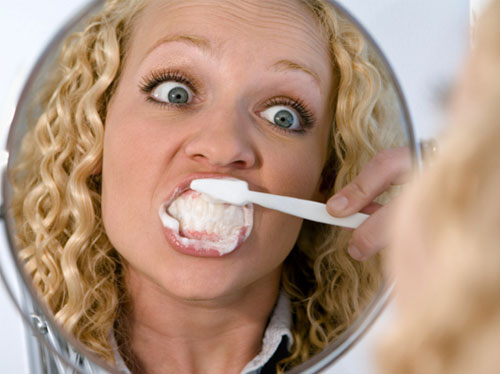
Are you hurting instead of helping your teeth when you brush? We pinpoint common brushing mistakes—and how to protect your pearly whites.

It’s not exactly a newsflash that one of the most important reasons to brush your teeth is to fight off cavities (not to mention prevent bad breath). But what if the way you brush your teeth actually makes you more susceptible to cavities, tooth decay and gum disease? Scary.

Turns out, there are a host of common mistakes that many of us make morning and night that can damage teeth and turn a healthy smile upside-down. Find out what you’re doing wrong—and how to break these bad habits for better teeth.

You don’t brush for long enough
Most people don’t spend nearly enough time brushing their teeth, notes prosthodontist Michael Lenchner. Most dentists recommend brushing for two or three minutes, but few people ever make it to that. Next time, check your watch see how long your routine takes. Chances are, whether you’re rushing to get to work or ready to collapse into bed, you’re only brushing for a minute or so. To go the distance, bring an egg timer into the bathroom and set it for two or three minutes before you get started, or use an electric toothbrush (like Sonicare) with a two-minute timer.

You’re not watching what you’re doing
Make a point to look in the mirror while you brush your teeth and see where the brush is actually going. It’s easy to miss the area right at the gum line, which is the most important part. That’s where plaque, tartar and bacteria can build up, which cause the gums to become inflamed and infected (aka gingivitis). Also keep a close eye on the back molars. If the brush head hits your cheek before you get to them you could miss them completely. Bonus: Paying better attention to your chompers will increase the likelihood that you’ll notice if something is awry, like chips, cracks or “bruxisms,” which are cupped out or overly shiny areas where your upper and lower teeth might be wearing into one another. Wearing away can also be a sign of TMJ problems, clenching or sleep apnea. Mention any unusual observations at your next dentist appointment.

Your technique needs a major makeover

Enamel is made of tightly packed, glass-like rods that extend out toward the surface of the tooth. When you brush side-to-side, these brittle rods can break, leading to cracks and weakening teeth. Dr. Lenchner likens it to sawing down a tree. Remember: Teeth are not trees. Hold the brush so the bristles are at a 45-degree angle to the surface of the teeth and brush in small circles. Focus on a few teeth at once, then move on to the next set, continuing around from one side to the other, top and bottom, front and back. It’s okay to brush in straight lines on the chewing surfaces. After completing your circles, brush away from the gum line to clear off loosened plaque and bacteria.

You’re brushing too hard
The chances of enamel breakage are greater when you brush too hard. And if you have a tendency to clench or grind, the stakes get even higher. Those habits combined with hard sideways brushing can cause notches near the gum line called abfraction lesions. With continued pressure, they can deepen into the tooth’s inner dentin and cementum layers. What’s more, aggressive brushing can be traumatic for sensitive gums, causing irritation and recession.

You’re using the wrong brush
Be sure to buy soft or ultrasoft brushes to minimize damage. Lenchner warns, though, that even soft bristled toothbrushes can cause abrasions if used incorrectly. He recommends Oral B or Sonicare soft brushes. “All of the electric toothbrushes are great tools if they help you brush longer and get you to the right places,” he says. If you’re willing to invest—to the tune of nearly $189—he is a big proponent of the newly released Emmi-Dent, which looks like an electric brush, but uses ultrasound pulses to kill bacteria without any brushing at all.

If you have a Water Pik, keep it on the lowest setting, even if it doesn’t feel like it’s doing much. Anything higher can erode your gum line. If your dentist gives you a special brush for cleaning implants or crowns, only use it as directed so you don’t disrupt proper gum growth.

As horrifying as it may sound, your toothbrush can be a veritable haven for germs, including strep and staph. You should replace a regular toothbrush every three months—sooner if the bristles look worn, frayed and bent. Over time, the bristles get damaged, like split ends in your hair, and bacteria nestle in those tiny tears. To minimize germs’ day-to-day growth, rinse your brush with hot water after use and allow it to dry completely.
Posted by CNNDD On 10:17 AM No comments READ FULL POST
Being a single parent isn't easy and the transition seems impossible. Here are some tips to help you cope.

Don't waste time being angry After relationship breakdown or sudden bereavement it is very easy to be angry to 'be left holding the baby' so to speak. This is unproductive and ultimately not good for you or your child as it feeds your negativity about the situation. This is easier said than done, but if you can avoid it then you can focus more on you and your child.

Plan for the future Even if you can only cope with planning next week then try to plan it in mind-numbing detail. Aside from anything else it helps with step one as your attention and time is taken up so that you don't have the time to dwell on the past.

As a single parent it is really important to become organised as you have to cope with EVERYTHING and this is easier with planning. If you are a stay at home parent this is particularly important as you have more time to dwell, become negative and if you stay at home all day you won't socialise with many adults which can lead to becoming depressed and unmotivated.

Try looking for free groups, such as toddler and baby groups at local libraries, churches, etc. If your child is at school then it may be worth looking for a part time job during that period, not just for the extra money, but for the social interaction. You will feel better if you are doing something for yourself every once in a while.

Don't be afraid to say no to things that drain your time and energy, such as volunteering at your child's school or fundraising for the PTA.

Be consistent in your parenting. Establish house rules and stick to them, such as early bedtime on school nights.

If you are a working parent then it is also very important as you need to balance work and home life (try searching articles to help with this) and need to arrange a back up in case you don't reach your child's school etc on time.

Plan meals, including school lunches, several days in advance Shop for groceries once a week. Keep a few frozen or boxed meals on hand for evenings when you're running late. Fast-food meals should be an occasional treat instead of a habit.

Set up a support network If your child is at school or nursery then socialise with the other parents. Make friends arrange play dates etc. This is important as it helps your child make friends, but it also helps establish a support network so if you are caught in traffic you can ring another parent to pick up your child from school. Make sure you are prepared to return the favors!

Don't expect too much of yourself If you have a meltdown one day and find yourself in tears, don't be upset with yourself. Pick yourself up, accept that everyone struggles occasionally and try again. Be honest with your child; it's perfectly fine to say that you are short-tempered because you had a bad day at work.

Have time for yourself Make sure you can schedule yourself some time, if you can't afford a babysitter etc then get your child in a routine of going to bed at a certain time and have an hour when they are in bed where you don't do any housework or chores and you do something you like, such as a glass of wine and a film, a long chat with an old friend on the phone, etc. You will feel better for it and it stops life feeling like one long chore, which is no good for you or your child.

Be financially stable You have to deal with everything now so be organised. Write down what is going in each week, what needs to be spent and how much spare money there is. Be aware that there will be many unexpected costs (such as your child suddenly growing out of all the trousers in the house!) and you need to be saving money for that eventuality. Make sure you are getting everything you are entitled to such as tax credits, child benefit, income support etc.

Have fun Make sure you do an enjoyable activity with your child at LEAST once a week, that way you remember the joys of parenthood as well as the stress and worry.

If you are separated from an ex, then try your best to put your child first Make sure you focus on your child's best interest before your anger. If your ex is dating someone, don't pump the child for information about that person.

Focus on what suits your child, if your ex pays nothing and turns up less than once a month then rather than fighting this and trying to make them a responsible parent try and focus on being a good parent yourself and see if your child is happy with the arrangement. If they are, then by all means contact child maintenance, but make sure that you don't contact your ex about money or hassle him to turn up more as this will just become an argument.

If it distresses your child then talk to your ex calmly to explain this. Rather than screaming at him or her 'Josh waited two hours for you to turn up and you didn't even ring to say you wouldn't be there. He was in tears all night all because you are a terrible parent!' try saying something like' this arrangement isn't good for Josh as he wants to see more of you and he gets very upset when he expects to see you and then you aren't there. If things are too busy for you then I understand that but Josh doesn't so you need to decide if you have the time to see him. If not then it's a shame for both of you but I understand and josh will adapt eventually as long you stay away and give him time to deal with being without you. What he can't cope with is the inconsistency. I am leaving it up to you to decide and you can let me know.' If you are calm and reasonable then your ex may consider the situation rather than reacting to your anger.
Posted by CNNDD On 2:17 AM No comments READ FULL POST
Think about it: If you’re feeling sleepy at work, you may be tempted to reach for a cup of coffee (or several cups) and a doughnut for a quick shot of energy. Later you may skip the gym and pick up takeout on your way home to your family -- no time to cook. When you finally find yourself back in your bed, you are too wound up to sleep.

It’s a vicious cycle, and eventually this sleep deprivation can sabotage your waistline and your health.

It starts out innocently enough. “When you have sleep deprivation and are running on low energy, you automatically go for a bag of potato chips or other comfort foods,” saysSusan Zafarlotfi, PhD, clinical director of the Institute for Sleep and Wake Disorders at Hackensack University Medical Center in New Jersey.

The immediate result? You may be able to fight off sleepiness. The ultimate result? Unwanted pounds as poor food choices coupled with lack of exercise set the stage for obesity and further sleep loss.

“Sleep debt is like credit card debt,” Zafarlotfi says. “If you keep accumulating credit card debt, you will pay high interest rates or your account will be shut down until you pay it all off. If you accumulate too much sleep debt, your body will crash.”

Not getting enough sleep is common -- even talked about with pride. “We brag about an all-nighter, but we do pay a price for staying up late and getting up early,” says Mark Mahowald, MD, director of the Minnesota Regional Sleep Disorders Center in Hennepin County.

Understanding the sleep-diet connection

The sleep-diet connection is regular fodder for diet books and magazine articles. Maybe you have even heard about the sleep diet, which suggests you can lose weight while you catch your ZZZs.

And it’s true, sort of.

“It’s not so much that if you sleep, you will lose weight, but if you are sleep-deprived, meaning that you are not getting enough minutes of sleep or good quality sleep, your metabolism will not function properly,” explains Michael Breus, PhD, author of Beauty Sleepand the clinical director of the sleep division for Arrowhead Health in Glendale, Ariz.

On average, we need about 7.5 hours of quality sleep per night, he says. “If you are getting this already, another half hour will not help you lose 10 pounds, but if you are a five-hour sleeper and start to sleep for seven hours a night, you will start dropping weight.”

Exactly how lack of sleep affects our ability to lose weight has a lot to do with our nightly hormones, explains Breus.

The two hormones that are key in this process are ghrelin and leptin. “Ghrelin is the ‘go’ hormone that tells you when to eat, and when you are sleep-deprived, you have more ghrelin,” Breus says. “Leptin is the hormone that tells you to stop eating, and when you are sleep deprived, you have less leptin.”

More ghrelin plus less leptin equals weight gain.

“You are eating more, plus your metabolism is slower when you are sleep-deprived,” Breus says.

The sleep-weight loss solution

So what can you do about sleep deprivation?

A lot, says Breus. First, look at how much you sleep vs. how well you sleep. “Some people such as new moms may only get to sleep for a four-hour stretch. And there are some people who get 7.5 hours of sleep that is poor quality because of pain or an underlying sleep disorder, and this has the same effect as if they got less sleep,” he says.

Trouble-shoot both with improved sleep hygiene, he says.

For starters, avoid any caffeine in the afternoon because it will keep you in the lighter stages of sleep -- which are associated with poor sleep -- at night. Breus recommends only decaf from 2 p.m. on. Exercise also helps improve sleep quality. How soon before bed should you exercise? It depends -- everyone is different. It’s more important that you exercise than it is when you exercise. Breus says to be safe, don’t exercise right before going to bed. “But some people exercise better before bed and it doesn’t affect their sleep,” he says.

Watch what you eat before bedtime. “Pizza and beer before bedtime is not a good idea,” says Breus. “Neither is eating a big meal close to bedtime.” He suggests eating a few healthy snacks and then having a light meal -- like a bowl of cereal -- if you’re running close to bedtime. Heavy, rich meals before bed can also increase risk of heartburn, which will certainly keep you up all night.

What if you are getting enough hours of sleep but wake up and feel sleepy the next day? “Talk to your doctor about seeing a sleep specialist,” Breus says. After conducting a thorough evaluation and sleep study, in which you are monitored while sleeping, the sleep specialist can help identify any underlying problem. Together you can develop a treatment plan so that you get more high-quality sleep -- and maybe even slim down.
Posted by CNNDD On 2:14 AM No comments READ FULL POST

Sunday, June 2, 2013


Ingredients (one person):

150g couscous
1 red pepper
1 tomato
A few leaves of fresh mint
1 bunch parsley
10 black olives
1 lemon
Salt and pepper
4 tbsp. tablespoons olive oil

preparation:

Put the couscous in a bowl, pour in the same amount of hot, lightly salted water. cover
and let rise.

In another bowl mix the tomato and pepper diced, chopped herbs, the juice of oil
lemon a little salt and pepper.

Fluff the cooled couscous with a fork. mix with the preparation and olives. refrigerate
least 1 hour or better overnight for the salad is well flavored.

Posted by CNNDD On 3:34 AM No comments READ FULL POST

Saturday, June 1, 2013

Ingredients:

2 cups Poha (Beaten Rice)
1 Potatoes
1 Onions
2 Green Chillies
1 tsp Chana dal
1 tsp Urad dal
1/4 tsp Mustard Seeds
1 sprig Curry leaves
2 tsp Peanuts
4 tblsp Oil
1 pinch Turmeric powder
1 Lemon
Few Corainder leaves
Salt to taste 
How to make aloo poha :

  • Soak the poha in water. Wash and drain all the water.
  • Add some salt , turmeric powder , keep aside.
  • Peel and cut the potatoes into small cubes, chop the onions, chillies, corainder leaves.
  • Heat oil and put chana dal, urad dal, mustard seeds, peanuts, curry leaves and fry until they crackle.
  • Add potatoes , saute for few minutes, then add chopped onions, chillies.
  • Cook till they are done. Add the poha, corainder leaves and stir.
  • Keep it on slow flame for 5- 7 minutes.
  • Let it cool for sometime and add then lemon juice.
 
Posted by CNNDD On 10:28 AM No comments READ FULL POST

Friday, May 31, 2013

  • Walk into any doctor’s office around the country and chances are that you'll be the one in the hot seat. In fact, you probably assume that it's your M.D.’s responsibility to ask the questions, and it's your job to answer them. But your health—indeed, your very life—might depend on whether you ask a few key questions of your own.
  • "Do I really need this test?"

    "Doctors often adhere to a better-safe-than-sorry philosophy, ordering tests just to protect themselves in the event of a lawsuit," says David Sandmire, M.D., coauthor of Medical Tests That Can Save Your Life. A full 16 percent of prostate-cancer screenings, for example, are unnecessary, say Harvard researchers. Since 80 percent of PSA results are false positives, thousands of men undergo needless biopsies each year. Another overused procedure: CT scans. The radiation from these tests causes an estimated 5,695 cancer cases a year, say British researchers.
Posted by CNNDD On 12:03 PM No comments READ FULL POST
 Ingredients:
45 ml olive oil
1 medium onion
400 g chicken fillet
2 cloves of garlic
1 green chili
¼ tsp salt
¼ tsp turmeric
½ tsp ground cumin
¼ tsp ground coriander
1 tsp tomato purée
1 tsp curry paste
30 ml double cream

Preparation:
-         Chop a medium sized onion
-         Crush 2 cloves of garlic with the side of a knife.
-         Chop a green chilli.
-         Heat a frying pan over a medium heat. Add 3 tablespoons of vegetable oil
-         Put the chicken in, and continue to fry for 5 to 6 minutes. The chicken will start to cook, and turn entirely white on the outside.
-         Put the garlic and chilli into the pan, and stir. Carry on frying gently over a medium heat, until everything is golden brown.
-         Put 1/4 teaspoon of salt, 1/4 teaspoon of turmeric, 1/2 teaspoon of ground cumin and 1/4 teaspoon of ground coriander in the pan. Stir well.
-         Add 1 teaspoon of tomato purée, and 1/4 teaspoon of curry paste, Stir, and fold 2 generous tablespoons of double cream into the mixture.
-         Serve hot with freshly cooked basmati rice.
Posted by CNNDD On 11:41 AM No comments READ FULL POST
This realbuzz.com article aims to give the low-down on these two potentially life-threatening conditions and suggest ways of spotting potential problems and getting men away from the ‘head in the sand’ approach to their health.
While women seems to accept that regular breast screening and smear tests are a necessary fact of life, men in general still have a reluctance to get themselves checked over or indeed check themselves over. But come on fellas, do you really need an excuse to get playing with yourself?
Seriously though, testicular and prostate cancer can be killers, but the good news is they are nearly always curable provided they are spotted early enough.

So what is testicular cancer and what are the signs to look out for?

Testicular cancer affects the testes and is the most common cancer among young men between the ages the ages of 19 and 44, so it’s certainly not something to be written off as a disease that will only affect you in later life. The chances of the average man developing testicular cancer is approximately one in 450.
Several high profile characters such as Lance Armstrong — who made a full recovery and went on to win the Tour de France several times — have proved that being diagnosed with testicular cancer is most definitely not a death sentence.

Causes and prevention of testicular cancer

The causes of testicular cancer are unknown, although there is a suggestion that it may be hereditary, so if you have a close male relative who has had testicular cancer, then your chances of getting it are increased greatly, possibly by as much as 10 times.  Also men who had an undescended or partly descended testicle are also considered five times more likely to develop testicular cancer.
Research suggests that getting off your backside and taking regular exercise may prevent testicular cancer from developing, but until more is known, the only real advice is to check your testicles regularly, so there’s an excuse to get playing with your balls!
Check your testicles at least once a month using your fingers and thumbs to look for any changes in shape, size, consistency and smoothness. If one testicle is larger or hangs lower than the other, don’t panic, that is quite common. Self-examination is best done after a bath or shower when the scrotum is relaxed.
Ignoring these checks is not an option, nor is ignoring anything that you find. If you discover anything unusual — such as any lumps, enlargement of the testes, feelings of pain or discomfort in the scrotum or groin — make sure you see your doctor. Try not to be embarrassed, after all, the doctor has seen it all before! They key to it all is regular checks and acting quickly on anything you (or maybe even your partner!) find. 

So what is prostate cancer and what are the signs to look out for?

Unlike testicular cancer, which can affect young men, prostate cancer largely affects men over the age of 50. It is the most common form of cancer in men.
The causes of prostate cancer are not fully understood yet, but there is a school of thought that a high-fat, high-meat, low-vegetable diet can contribute greatly to the risks of developing the disease. Hereditary factors are also thought to play a part, so, anyone with a strong family history of prostate cancer is considered at greater risk.
Prostate cancer often doesn't cause symptoms in its early stages, but common signs can include difficulty in urinating, a weak stream of urine, urinating more frequently, pain while urinating, blood in the urine, and pain or stiffness in the lower back, pelvis and hips. It’s fair to say that all these symptoms can be caused by other non-cancerous medical conditions, so don’t panic, but be sure to get checked out.

Preventing prostate cancer

There is no sure-fire way to prevent prostate cancer, but eating a healthy, low-fat diet may help, and the added bonus is, many of the tips also help with preventing heart disease.
It’s a fact that prostate cancer rates are highest in countries where people tend to consumer a lot of fat in their diets. A diet high in saturated fats (such as animal fats found in red meat) may pose the greatest risk, so minimize consumption of these and consume more omega-3 rich fish instead. 
A diet high in fruits and vegetables has been linked to a lower risk of various kinds of cancer, so will certainly do no harm. Blueberries and tomatoes have been suggested to be particularly helpful in protecting against prostate cancer, as has green tea and cranberry juice, so be sure to include them in your diet.
Posted by CNNDD On 11:40 AM No comments READ FULL POST
Ingredients:
4 chicken breasts, chopped in cubes
3 c. chicken broth
1 1/2 c. couscous
1 tbsp. chopped fresh parsley
1/2 tsp. thyme
2-3 c. green peas
1/2 green pepper, diced
2 tbsp. raisins
2 tbsp. lemon juice
2 tbsp. olive oil
1 tsp. curry powder
Pinch of ground black pepper
Pinch of red pepper flakes
1/4 c. chopped nuts

Method:
Cook the chopped chiken.
Boil the broth and add the couscous, parsley, and thyme and cook the mixture for 30 seconds. Remove the pan from the heat, cover it and let the couscous stand for 5 minutes.
Steam the peas until just tender and place in a large bowl, add the green pepper, chicken and raisins. Pour the hot couscous over the chicken.
In a separate bowl, combine the lemon juice, curry, oil, black and red pepper. Pour this mixture over the couscous mixture and refrigerate for 1 hour. Sprinkle the salad with nuts before serving.
Posted by CNNDD On 11:35 AM No comments READ FULL POST

Think your kids are too young to understand your grown-up conversations? Think again.

"In my practice, parents are constantly shocked by what kids have overheard," says Brad Sachs, PhD, a family psychologist in Columbia, MD and author of The Good Enough Child and The Good Enough Teen.

"But as soon as children can talk, they're listening to what you say," he says.

Kids can be upset and confused by overheard adult conversations. But they may not tell you what they heard -- and you won't even know they're worried.

Before your kid repeats something mortifying in front of your mother-in-law -- or worse -- it's time to start speaking more carefully.
Talking Around the Kids: 6 Things to Avoid

What shouldn't you discuss when little ears could hear?

Fraught topics: Be careful talking with your spouse about big issues -- like financial problems or a family crisis. Your kids are listening. Kids are magnetically drawn toward arguments and emotional discussions, says Eileen Kennedy-Moore, PhD, a psychologist in Princeton, N.J., and coauthor of Smart Parenting for Smart Kids: Nurturing Your Child's True Potential. However, they may not really understand what's going on. Their interpretations may be scarier than what's actually happening.

What to do instead: "If something big is going on in your household, trying to hide it from your kids won't work," says Kennedy-Moore. "Give them the basic facts." The most important detail is how these changes will affect your child.

Trash talk: Are you always criticizing about your child's teacher, your mother, or your ex-husband?

What to do instead: Stop. You're modeling bad behavior for your kids. You may also say something mean about a person your kids care about -- and that can be deeply unsettling for them.

Criticism of your kids: Do you tend to vent about the frustrations of parenthood on the phone? Be careful. "It can be really hurtful if your kids overhear you criticizing them or talking about some mistake they made," says Kennedy-Moore. "They're likely to feel ashamed and then angry."

What you should do instead: Don't get in the habit of complaining about your kids. "Be discreet about your kids' indiscretions," says Kennedy-Moore. Try not to repeat them to others.

Complaining: Adults tend to complain a lot -- especially about their jobs. What's the problem? You're modeling a bad attitude that your kids could apply to school -- or later in life when they have jobs.

What you should do instead: Talk about the positive aspects of your work. "If you worked on an interesting project recently, make sure to mention that," says Kennedy-Moore.

Upsetting world events: "For kids, the world is a small place," says Kennedy-Moore. "They may overhear you talking about the news and assume that burglars are going to be coming to their house, or a tsunami may hit their town."

What you should do instead: You shouldn't shield your kid completely from world events. Just help them put the news in context and reassure them, Kennedy-Moore says.

Swearing: Many adults swear in front of their kids on occasion. Don't overreact when your kids imitate you -- that will just make the words more exciting.

What you should do instead: Try hard not to swear in front of your kids -- and never swear at them, says Kennedy-Moore. If you can't seem to control your profane outbursts, Kennedy-Moore has a suggestion. "Tell your kids to collect a quarter from you every time you swear," she tells WebMD. "They'll like doing that a lot."

Even if you're careful, your kids will wind up overhearing things that they shouldn't. Here are tips on how to handle that when it happens -- as well as suggestions for making it less likely.

Ask what they heard: If you suspect your kids have overheard something, ask them. Tell them that they won't get in trouble if they tell the truth. They probably know that eavesdropping is wrong, so they may not want to reveal it.

Reassure them: Help your kids put what they heard in perspective. If they're upset about an argument you had with your spouse, explain that adults sometimes disagree but that you'll work it out -- and that arguments do not mean you're getting a divorce.

Be proactive: Don't think you can hide something big from your kids -- like losing a job or the illness of a close relative. "Trying to keep kids in the dark about things like that just doesn't work," says Sachs. Instead, level with them in an age-appropriate and reassuring way. You'll spare them a lot of confusion and anxiety later.

Get privacy when you need it: Have something sensitive you need to discuss? Do it somewhere else. Go for a walk. Close the bedroom door for a few minutes. Don't try to whisper or talk in code and hope your kids won't notice.

Allow selective eavesdropping: There is one real benefit to a child's tendency to listen in.

"One of the best ways to praise the child is indirectly," says Kennedy-Moore. "If your child overhears you talking to grandma about how hard she is working in math class, that can really boost the child's self-esteem." Kids are more likely to believe your praise when you're not saying it to them.
Posted by CNNDD On 7:47 AM No comments READ FULL POST

Tuesday, May 28, 2013

The British Dental Association has urged parents to stop giving their children juices and smoothies because of the high sugar released in the crushing process.
Around 25 percent of UK toddlers regularly consume fruit juice while two thirds eat sugary sweets and snacks, the UK's Daily Mail reported.
In Australia, one in four parents feels guilty about their children drinking fruit juice, according to an industry report titled Getting the Guilts: Parents on Kids' Food.
Released in January, the survey found over half the parents said their children drank fruit juice at least three times a week. And of those parents who felt guilty about their children drinking juice, 73 percent attributed this guilt to being unsure whether it was the healthiest choice.
While the 2013 Australian Dietary Guidelines say that a small glass (125ml) of 100 percent fruit juice can contribute to a daily fruit serve, Dr Nigel Carter, chief executive of the British Dental Health Foundation, told the Daily Mail a different story.
"Fruit juices are becoming increasingly popular and the fruit content can make them seem like a good idea," he said.
"However, they contain very high levels of sugar and acid and so can do a lot of damage to the teeth.
"At such a young age it is unrealistic to remove sweet foods and drinks altogether from a child's diet. To combat this, it is important to try to keep their consumption to mealtimes, and ensure they only drink water or milk between meals.
"Bear in mind it is better for the child's teeth and general health if they have three meals a day instead of seven to 10 'snack attacks', many of which will contain sugar."
The warning comes after a study by the Daily Mail found a 500ml serving of Ribena blackcurrant juice contains the same sugar as 13 Oreo biscuits.
So why is it worse to drink juice than eat fruit? Professor Laurence Walsh, head of the School of Dentistry at the University of Queensland, has said it's not just the concentrated sugar that's the problem.
Juices contain acids that can dissolve the enamel of the tooth, leaving the inner parts of teeth exposed, which leads to sensitivity.
"That's why if people drink either large amounts of orange juice or are regular users of soft drink, they start to notice that their teeth get sensitive as the acids dissolve the outside structure of the teeth," Walsh told the ABC.
Making the mouth more acidic also encourages the growth of cavity-causing bacteria.
But juice it is also contributing to weight problems. Fibre is removed in the juicing process, so there is nothing to line the intestine and slow the absorption of sugar, which will turn to fat if not used.
Walsh recommended limiting kids' juice consumption by choosing, 100 percent fruit, no added sugar options and diluting it with water. He also said using a straw will be better for the teeth in the long run.
Posted by CNNDD On 3:29 PM No comments READ FULL POST

Followers